

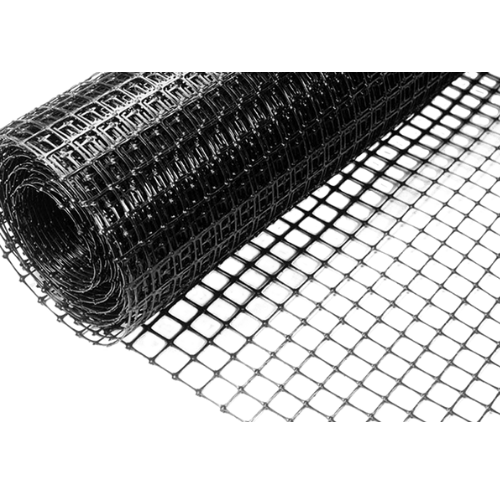
Can a Geogrid Reduce Aggregate Thickness?
Choosing the correct ground stabilisation solution can have a significant impact on both construction costs and long-term pavement performance.
One of the most common questions asked by contractors, developers and engineers is whether installing a geogrid can reduce the amount of aggregate required for a project.
The simple answer is:
Yes- in many situations, a correctly designed geogrid system can reduce the thickness of the aggregate layer required while maintaining or improving the performance of the construction.
However, the amount of reduction will always depend on the site conditions, loading requirements and the pavement design.
In this guide, we’ll explain how geogrids work, when aggregate reductions may be possible and why every project should be assessed on its own engineering requirements.
Topics Covered
- Can a geogrid reduce aggregate thickness?
- How does a geogrid reduce aggregate requirements?
- What factors affect aggregate thickness?
- Can a geogrid reduce construction costs?
- Typical applications
- Frequently asked questions
- Choosing the right geogrid for your project
- Frequently asked questions
How Does a Geogrid Reduce Aggregate Requirements?
To understand how a geogrid may reduce aggregate thickness, it’s important to first understand what happens when aggregate is placed directly onto weak ground.
Without reinforcement, the aggregate can spread laterally under load. As vehicles pass over the surface, the stone gradually moves sideways into the weaker subgrade, reducing the efficiency of the pavement structure over time.
A geogrid is designed to reduce this lateral movement.

Aggregate being placed over a biaxial geogrid during construction. As the aggregate interlocks within the geogrid apertures, loads are distributed more efficiently across the pavement structure.
When aggregate is compacted into the apertures of the geogrid, the two materials interlock to create a stronger composite layer. Instead of individual stones moving independently, the aggregate works together to distribute loads more effectively across a wider area.
This improved load distribution can increase the efficiency of the pavement structure. On suitable projects, this may allow engineers to optimise the pavement design, potentially reducing aggregate thickness while maintaining the required performance.
It is important to remember that this is not guaranteed on every project. Any potential reduction should always be based on the site conditions, traffic loading and an appropriate pavement design.
What Factors Affect Aggregate Thickness?
One of the biggest misconceptions about geogrids is that they reduce aggregate thickness by a fixed amount.
In reality, there is no standard reduction that applies to every project.
The amount of aggregate required will always depend on the design of the pavement and the conditions on site.
Some of the key factors include:
- The strength of the existing subgrade
- The expected traffic loading
- The type and quality of the aggregate
- The design life of the construction
- Groundwater and drainage conditions
- The geogrid specification being used
For this reason, geogrids should always be considered as part of the overall pavement design rather than as a simple way of reducing stone.
Where appropriate, an engineered geogrid solution may allow the pavement structure to be optimised, potentially reducing excavation depths, imported aggregate and overall construction costs.
However, every project should be assessed on its own merits to ensure the design achieves the required long-term performance.
Can a Geogrid Reduce Construction Costs?
In many projects, reducing aggregate thickness isn’t the end goal—it’s the potential cost savings that come with a more efficient pavement design.
Where a geogrid forms part of an engineered solution, optimising the pavement structure may help reduce overall construction costs in several ways.
Potential benefits can include:
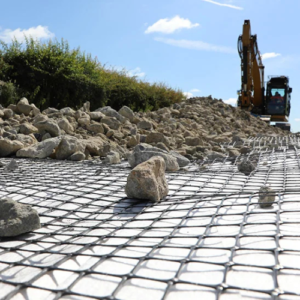
Aggregate being placed over a biaxial geogrid during road construction. As the aggregate interlocks within the geogrid apertures, the pavement structure distributes loads more efficiently, helping engineers optimise the pavement design where appropriate
- Reduced aggregate requirements
- Less excavation
- Fewer imported materials
- Reduced wagon movements
- Lower disposal costs for excavated material
- Faster construction programmes
- Reduced carbon emissions associated with material transport
These benefits will vary from project to project and should never be assumed without an appropriate pavement design.
In some cases, the greatest saving isn’t simply the reduction in aggregate thickness. It may be the ability to construct a working platform over poor ground conditions, reduce programme delays or avoid more extensive ground improvement works.
For this reason, geogrids should be viewed as an engineering solution designed to improve the efficiency of the pavement structure rather than simply a product that reduces stone.
Where the site conditions and pavement design allow, the resulting construction efficiencies can deliver significant commercial benefits over the life of the project.
Typical Applications
Geogrids are used across a wide range of civil engineering and construction projects where improving the performance of the pavement structure is a key objective.
Typical applications include:
- Temporary haul roads
- Permanent access roads
- Working platforms
- Car parks
- Industrial yards
- Construction compounds
- Housing developments
- Renewable energy projects, including solar farms
- Rail and infrastructure projects
- Agricultural access tracks
In each of these applications, the objective remains the same: to improve the performance of the aggregate layer by distributing loads more efficiently and reducing lateral movement.
Where appropriate, this may allow engineers to optimise the pavement design, potentially reducing aggregate requirements while maintaining the required level of performance.
The most suitable geogrid and pavement design will always depend on the site conditions, expected loading and the performance requirements of the project.
Every Project Should Be Assessed Individually
While geogrids can play an important role in optimising pavement designs, there is no universal reduction in aggregate thickness that applies to every project.
The performance of a geogrid system will always depend on the combination of:
- Ground conditions
- Subgrade strength
- Traffic loading
- Aggregate specification
- Pavement design
- Design life of the construction
For this reason, reputable geogrid manufacturers and engineers assess each project individually before recommending a pavement design.
Rather than asking, “How much stone can I save?”, a better question is:
“What is the most efficient pavement design for my site conditions?”
Taking this approach helps ensure the construction performs as intended while identifying opportunities to optimise material use, reduce excavation and improve long-term value where appropriate.
If you’re considering a geogrid solution for your project, our team can help identify the most appropriate product and discuss the information needed to assess your application.
Frequently Asked Questions
Can a geogrid reduce aggregate thickness?
Yes, in many applications a correctly designed geogrid solution may allow the pavement structure to be optimised, potentially reducing aggregate thickness. However, any reduction will depend on the site conditions, traffic loading and pavement design.
Does a geogrid work on every site?
No. Every project is different. The effectiveness of a geogrid will depend on factors such as the strength of the subgrade, the expected loading, the aggregate specification and the overall pavement design.
Does a geogrid strengthen the ground?
A geogrid does not strengthen the natural ground itself. Instead, it reinforces the aggregate layer by improving load distribution and reducing lateral movement, helping the pavement structure perform more efficiently.
How much aggregate can a geogrid save?
There is no standard reduction that applies to every project. Any potential saving should be determined through an appropriate pavement design based on the specific site conditions.
Can a geogrid reduce construction costs?
Potentially, yes. Where supported by the pavement design, a geogrid may help reduce aggregate requirements, excavation, imported materials and construction time. The overall savings will always depend on the individual project.
Should I use a geogrid or a geotextile?
They perform different functions. Geogrids are primarily used to reinforce aggregate layers and improve load distribution, while geotextiles are used for separation, filtration, drainage and protection. In some applications, both products are used together.
Conclusion
A geogrid should never be viewed simply as a way of reducing aggregate thickness. Its primary purpose is to improve the performance of the pavement structure by reinforcing the aggregate layer and distributing loads more effectively.
Where the site conditions and pavement design allow, this improved performance may create opportunities to optimise aggregate thickness, reduce excavation and improve construction efficiency. However, every project should be assessed on its own engineering requirements rather than applying a standard reduction across all sites.
Understanding the ground conditions, loading requirements and design objectives is the first step towards selecting the most appropriate geogrid solution. By taking a project-specific approach, contractors and engineers can make informed decisions that balance performance, cost and long-term durability.
If you’re unsure which geogrid is best suited to your project, our team can help you identify the most appropriate solution based on your site conditions and application.
Related Products
- Geoworks TerraGrid Core 30 Biaxial Geogrid
- Geoworks TerraGrid Core 40 Biaxial Geogrid
- Geoworks TerraGrid Core Composite 3030
- Geoworks FasTrack Orange Woven Geotextile
- Geoworks MultiTrack 1000 Non-Woven Geotextile
