

Topics Covered
- What is geotextile fabric?
- Why are some geotextiles orange?
- Orange geotextiles as warning layers
- Separation and ground stability
- Separation and filtration geotextiles
- Protection geotextiles
- Ground reinforcement applications
- Choosing the right geotextile
- Frequently asked questions
Why Are Some Geotextiles Orange?
Geotextiles are widely used throughout the construction, civil engineering, drainage and environmental sectors. While most geotextiles are white, grey or black, some products are deliberately manufactured in bright orange. 
This often leads to the question: does the colour serve a purpose, or is it simply a manufacturing choice?
In many cases, orange geotextiles are specifically designed as highly visible separation and warning layers, helping to identify changes in ground conditions and alert future excavators to what lies beneath. However, as with all geotextiles, it is the specification and intended function of the product that ultimately determines its suitability for a project.
What Is Geotextile Fabric?
Geotextile fabric is a permeable textile material used in civil engineering, drainage, landscaping and ground stabilisation projects.
Depending on the application, geotextiles can perform one or more of the following functions:
- Separation
- Filtration
- Drainage
- Protection
- Reinforcement
Geotextiles are commonly installed beneath:
- Roads

- Driveways
- Access tracks
- Car parks
- Drainage systems
- Attenuation tanks
- Ground reinforcement schemes
- Solar farm infrastructure
- Industrial developments
The type of geotextile selected will depend on the requirements of the project rather than the colour of the material.
Why Are Some Geotextiles Orange..explained?
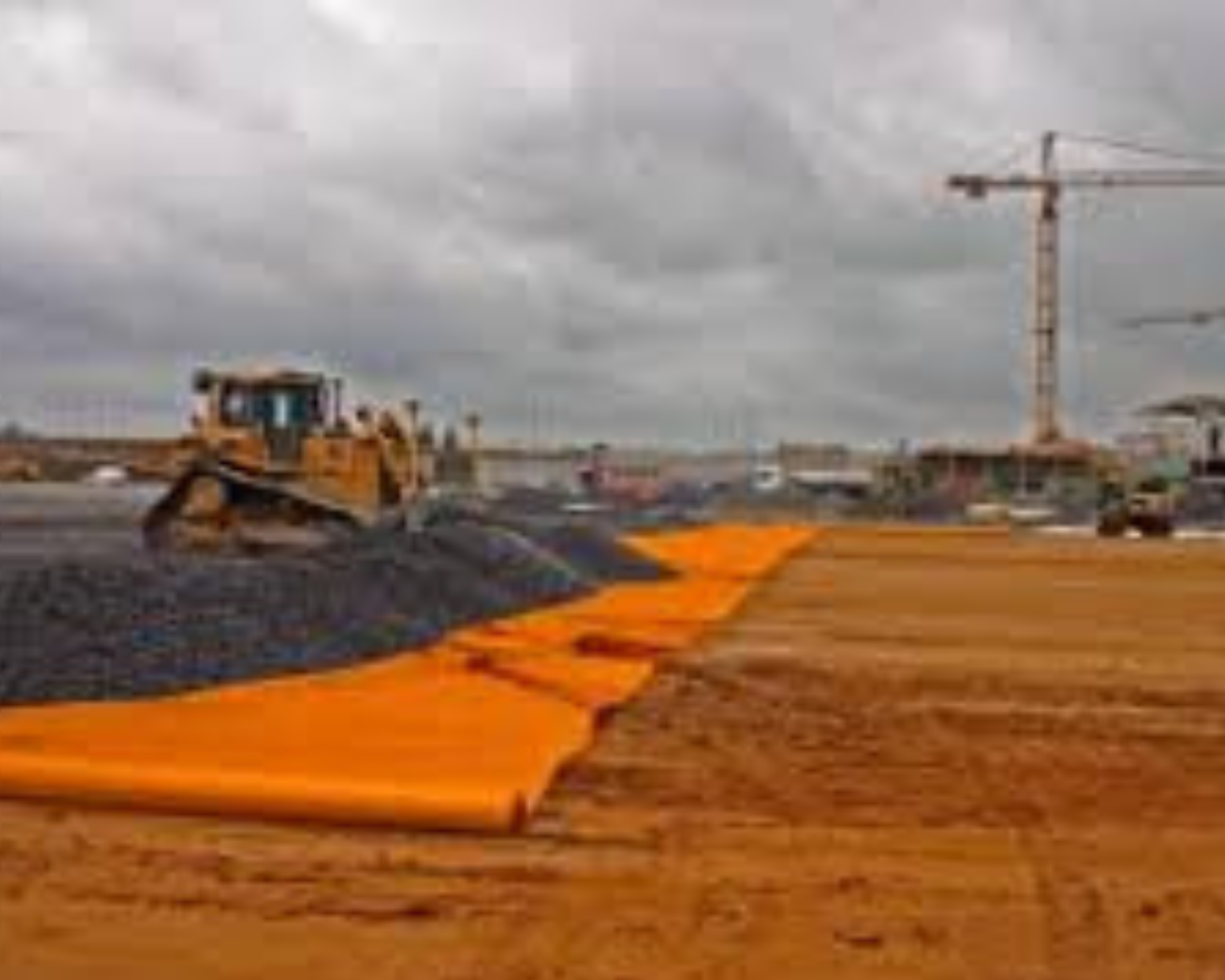
Unlike many standard geotextiles, certain specialist products are manufactured in bright orange to create a highly visible layer within the ground.
The colour helps identify the presence of a separation layer during installation and can also act as a warning marker for future excavation works.
Examples include products used on contaminated land schemes, brownfield developments and environmental remediation projects where it is important to distinguish between different soil layers.
While orange geotextiles are often associated with warning and separation applications, the colour itself does not determine the performance of the material. Tensile strength, permeability, durability and intended function remain the key factors when selecting a geotextile.
Orange Geotextiles as Warning Layers
One of the most common uses for orange geotextiles is as a highly visible warning layer.
On contaminated land projects, an orange geotextile may be installed between contaminated and uncontaminated materials to create a clear visual indicator for future excavation works.
This can help:
- Identify changes in ground conditions
- Reduce the risk of cross-contamination
- Alert contractors to the presence of engineered ground systems
- Assist with future maintenance and excavation activities
The bright orange colour provides a clear contrast against surrounding soils and aggregates, making it easier to identify years after installation.
Separation and Ground Stability
Many orange geotextiles are also designed to provide separation between the subgrade and aggregate layers.
Without an effective separation layer, fine soils can migrate into the aggregate, reducing drainage performance and weakening the sub-base over time.
By maintaining separation between different materials, geotextiles help:
- Improve sub-base performance
- Reduce aggregate contamination
- Maintain drainage characteristics
- Extend the lifespan of the construction
Typical applications include:
- Access roads
- Haul roads
- Hardstandings
- Construction compounds
- Industrial developments
Separation and Filtration Geotextiles
Not all geotextiles are used as warning layers.
Many non-woven geotextiles are primarily specified for separation and filtration applications where water must be allowed to pass through while preventing the migration of soil particles.
These products are commonly used in:
- Drainage trenches
- French drains
- Highway drainage systems
- Car parks
- Access roads
- General civil engineering projects
By maintaining the integrity of drainage systems, filtration geotextiles help ensure long-term performance.
Protection Geotextiles
Heavier non-woven geotextiles are often used as protection layers within engineered containment systems.
Typical applications include:
- Attenuation tanks
- Geomembrane protection
- Pond liners
- Environmental containment systems
- Water management infrastructure
In these applications, the geotextile acts as a protective cushioning layer between the geomembrane and surrounding ground conditions, helping to minimise the risk of damage from angular aggregates, irregular subgrades and installation activities.
Ground Reinforcement Applications
Geotextiles are frequently used alongside geogrids and geocomposite products where additional ground stabilisation is required.
In these situations:
- The geotextile provides separation and filtration.
- The geogrid provides reinforcement and load distribution.
Together they help improve ground performance while reducing the risk of aggregate contamination and sub-base failure.
Common applications include:
- Haul roads
- Working platforms
- Solar farms
- Construction compounds
- Industrial yards
- Ground improvement schemes
Choosing the Right Geotextile
When selecting a geotextile, it is important to focus on the required function rather than the colour of the material.
Factors to consider include:
- Ground conditions
- Loading requirements
- Drainage requirements
- Aggregate size
- Installation conditions
- Design life of the project
A geotextile should always be selected based on its technical performance and suitability for the intended application.
Frequently Asked Questions
Why are some geotextiles orange?
Certain geotextiles are manufactured in orange to provide a highly visible warning and separation layer, particularly on contaminated land and environmental projects.
Does an orange geotextile perform differently to a white geotextile?
Not necessarily. Performance is determined by the product specification rather than the colour of the material.
What are orange geotextiles used for?
Orange geotextiles are commonly used as warning layers, separation layers and ground stabilisation products within civil engineering and environmental projects.
Can geotextiles improve ground stability?
Yes. Geotextiles help maintain separation between soils and aggregates, improving the long-term performance of roads, hardstandings and other structures.
Can geotextiles be used with geogrids?
Yes. Geotextiles and geogrids are frequently used together, with the geotextile providing separation and filtration while the geogrid provides reinforcement.
Conclusion
While the colour of a geotextile does not determine its engineering performance, orange geotextiles are often selected where high visibility, separation and warning functions are required.
Whether used on contaminated land projects, haul roads, hardstandings or ground stabilisation schemes, the key to selecting the right geotextile is understanding the specific requirements of the application and choosing a product with the appropriate technical performance.
Related Articles
- Geogrid vs Geotextile: What’s the Difference?
- What Is a Geogrid and How Does It Work?
- How to Stabilise Soft Ground for Roads and Working Platforms
- Choosing the Right Geotextile for Your Project
- Geogrids for Solar Farm Developments
